
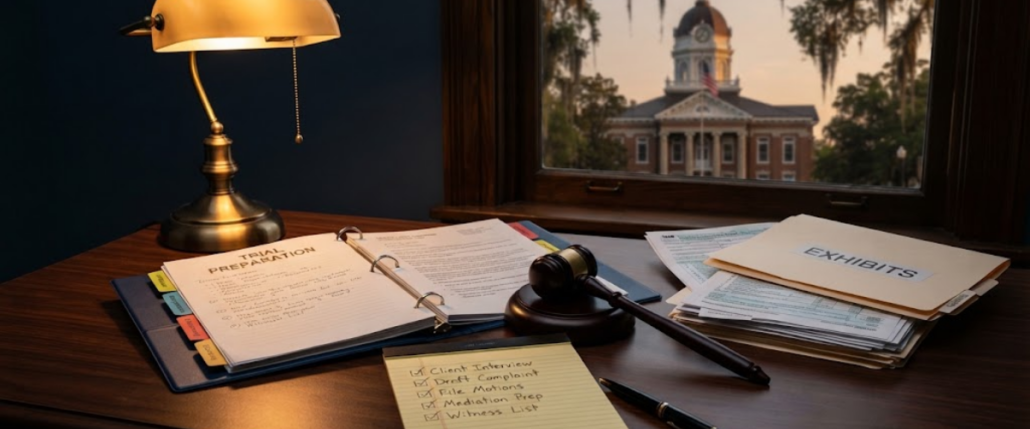
How Should I Prepare for My Alabama Divorce Trial?
The thought of standing in a courtroom to dismantle a marriage is overwhelming for almost anyone. Months of paperwork, temporary orders, and emotional strain often culminate in a single trial date. For families along the Gulf Coast, understanding the local legal process is the first step toward regaining control over your future. Preparation removes the mystery from the courtroom and allows you to approach your case with confidence.
What Happens During an Alabama Divorce Trial?
An Alabama divorce trial is a formal court proceeding where a circuit court judge hears evidence, reviews financial documents, and listens to witness testimony. Because Alabama does not use juries for divorces, the judge makes all final decisions regarding property division, alimony, and child custody based on the evidence presented.
Unlike the dramatic courtroom scenes depicted on television, a family court trial is typically a structured and orderly event. Your case will be heard as a bench trial. This means there is no jury box filled with your peers. Instead, a single judge presiding in the Mobile County Circuit Court or Baldwin County Circuit Court will serve as both the referee of the law and the decider of facts.
The proceedings begin with opening statements, though judges sometimes waive these to save time. Your legal team will present your case first by calling witnesses and submitting physical evidence. This evidence might include bank statements, text messages, or child custody evaluations.
After your attorney rests your side of the case, your spouse’s legal counsel will have the opportunity to present their evidence and call their own witnesses. The judge will carefully observe how each party behaves, taking notes on credibility and the factual basis of the claims. Once both sides rest, the judge may issue a ruling from the bench or, more commonly, take the matter under advisement and issue a written order weeks later.
How Long Does a Divorce Trial Take in Mobile or Baldwin County?
The length of an Alabama divorce trial depends heavily on the complexity of the marital estate and custody disputes. A standard trial may conclude in a single day, while high-asset divorces or heavily contested custody cases in Mobile or Baldwin County can stretch across multiple days or even weeks.
Court dockets in growing communities like Foley and Daphne are often heavily congested. Because judges have limited time, a trial scheduled for a single day must move efficiently. If you and your spouse are fighting over every minor household item, the trial will drag on, testing the court’s patience and draining your financial resources.
High-asset cases naturally take longer. When a trial involves business valuations, complex retirement accounts, or hidden assets, financial professionals must testify. Examining and cross-examining these individuals requires substantial court time.
Child custody disputes also extend the trial schedule. If a Guardian ad Litem or a child psychologist is called to the stand to discuss the well-being of the children, their testimony will be thorough. Your attorney will work with you beforehand to streamline your evidence, ensuring the court hears the most impactful information without unnecessary delays.
What Is the Divorce Discovery Process in Alabama?
Discovery is the formal legal process governed by the Alabama Rules of Civil Procedure where both spouses exchange relevant information before trial. This phase relies on tools like written interrogatories, document requests, and depositions to ensure transparency regarding finances, property, and personal conduct.
You cannot properly prepare for a trial if you do not know what evidence your spouse intends to use against you. The discovery phase eliminates courtroom surprises. Under Rule 26 of the Alabama Rules of Civil Procedure, both parties are legally required to disclose relevant facts and documents. Interrogatories are written questions that you must answer under oath. These questions often ask for a list of your assets, your employment history, or the specific reasons you are seeking primary custody.
Requests for production compel you to hand over physical or digital documents. Your spouse might request five years of tax returns, deeds to real estate, or statements from your retirement accounts. If your spouse refuses to turn over these documents, your legal counsel can file a motion to compel, forcing them to comply or face sanctions from the judge.
How Do I Gather Financial Documents for My Divorce?
Preparing for an Alabama divorce trial requires compiling a comprehensive record of your financial life. You must gather recent tax returns, bank statements, retirement account balances, mortgage documents, and pay stubs to provide the court with an accurate picture of the marital estate.
Financial transparency is not optional in family court. Trying to hide money or obscure your true income will severely damage your credibility. To build a strong case, you should start organizing your financial life the moment you realize a divorce is imminent.
You should aim to provide your attorney with the following documents:
- Three to five years of state and federal tax returns.
- Six to twelve months of statements for all checking and savings accounts.
- Current statements for all 401(k), IRA, and pension accounts.
- Pay stubs from the last three months.
- Mortgage statements and recent appraisals for any real estate.
- Titles to vehicles, boats, and recreational equipment.
- Statements detailing marital debts, including credit cards and personal loans.
Having these documents readily available saves you money in legal fees. It allows your attorney to spend their time analyzing the assets rather than chasing down basic paperwork. If your spouse controlled all the finances during the marriage, your legal team can use the discovery tools mentioned earlier to subpoena these records directly from financial institutions.
How Does the Judge Decide Who Gets What in Alabama?
Alabama is an equitable distribution state, meaning the judge divides marital property fairly, though not always equally. Under Title 30 of the Alabama Code, the court reviews the length of the marriage, each spouse’s earning capacity, and any marital misconduct before distributing assets and debts. Many people mistakenly believe that their property will be automatically split down the middle. This 50/50 division only applies strictly in community property states. In Alabama, equitable means fair, and fairness is entirely up to the judge’s discretion based on the specific facts of your life.
When reviewing your case under Title 30 of the Alabama Code, the court looks at the origin of the property. Assets you acquired before the marriage, or received as an individual inheritance, are generally considered separate property and are not divided.
For the marital property, the judge considers several factors. They will look at the health and age of each spouse. They evaluate the future earning potential of both parties. If one spouse sacrificed their career to raise children in Fairhope while the other built a lucrative business, the judge may award the stay-at-home parent a larger share of the assets or ongoing alimony to balance the financial scale.
Fault also plays a role in property division. If a judge determines that a marriage ended due to adultery, domestic violence, or habitual substance abuse, they can award the innocent spouse a greater percentage of the marital estate.
How Does the Ore Tenus Rule Affect My Divorce Trial?
Alabama family courts operate under the ore tenus rule, meaning the trial judge directly hears oral testimony and observes witness demeanor. This gives the local judge significant discretion in deciding who is credible, making your behavior, honesty, and composure on the witness stand critical to your case outcome.
The ore tenus rule is a foundational concept in Alabama family law. Because a transcript cannot capture a witness’s tone of voice, body language, or hesitation, appellate courts heavily defer to the trial judge’s interpretation of the facts. This rule means the judge sitting across from you has immense power. They are watching how you react to difficult questions. If you roll your eyes, interrupt the opposing counsel, or act defensively, the judge will note your lack of composure.
Because the trial court’s decision is so difficult to overturn on appeal, you must get it right the first time. Your credibility is your most valuable asset. Answering questions truthfully, respectfully, and calmly demonstrates to the court that you are a reliable and stable individual.
What Should I Expect During Witness Testimony?
During witness testimony, your attorney will guide you through direct examination to tell your side of the story. You, your spouse, and potentially expert witnesses or family members will take the stand under oath to discuss finances, parenting roles, or fault grounds contributing to the divorce. When it is your turn to testify, your lawyer will conduct a direct examination. They will ask open-ended questions designed to let you explain your situation in your own words. This is your opportunity to clearly outline your relationship with your children, your financial contributions to the household, and your goals for the future.
Other witnesses may also be called to support your case. Teachers, day-care providers, or close friends might testify about your parenting skills. Financial professionals might explain the valuation of a family business. The goal of direct examination is clarity. You want the judge to understand the timeline of your marriage and the reasoning behind your requests. Practice these questions with your legal team beforehand so you feel comfortable navigating the topics.
How Do I Prepare for Cross-Examination in Family Court?
Preparing for cross-examination involves practicing your responses with your attorney and learning to remain calm under pressure. Opposing counsel will ask pointed questions designed to challenge your credibility, so it is vital to listen carefully, answer truthfully, and avoid arguing with the lawyer.
Cross-examination is often the most stressful part of a trial. Your spouse’s attorney has a job to do: they want to find holes in your story, highlight your mistakes, and make you look unreasonable. They will use leading questions that often require a simple “yes” or “no” answer.
Do not let opposing counsel rattle you. Take a deep breath before answering every question. This pause gives you time to think and gives your own attorney a moment to raise an objection if the question is improper.
Keep these principles in mind when facing cross-examination:
- Listen to the entire question before speaking.
- Answer only what is asked. Do not volunteer extra information.
- If you do not understand a question, ask for clarification.
- If you do not know the answer, simply say, “I do not know.” Do not guess.
- Never argue, raise your voice, or show anger toward the opposing attorney.
- Always direct your final answers and your eye contact toward the judge.
Can We Settle Before the Trial Begins?
Yes, spouses can reach a settlement agreement at any point before the judge issues a final ruling. Many Alabama divorces settle during court-ordered mediation or pretrial conferences, which saves both parties the emotional stress and financial cost of a full trial. Courts actually prefer that families resolve their own disputes. Judges in Mobile and Baldwin County frequently order parties to attend mediation before allowing a case to proceed to trial.
During mediation, a neutral third party helps you and your spouse negotiate a compromise. The mediator cannot force you to agree, but they can offer a realistic perspective on how a judge might rule. Even if mediation fails initially, settlements often happen on the courthouse steps just days before the trial. Preparing diligently for trial is the best way to secure a good settlement. When the opposing side sees that you have organized evidence and strong legal arguments, they are often more willing to negotiate a fair deal to avoid a courtroom loss.
What Are the Final Steps Before My Court Date?
In the weeks before your Alabama divorce trial, you and your attorney will finalize your witness list, organize trial exhibits, and hold a comprehensive pretrial preparation meeting. This final review ensures all evidence is marked, arguments are structured, and you know exactly what to expect in the courtroom.
The final weeks of preparation are intense but necessary. You will sit down with your legal counsel to review every document that will be submitted to the judge. This ensures you are familiar with the financial spreadsheets and communication logs that will be referenced during your testimony.
Your final preparations will generally include:
- Reviewing your spouse’s expected arguments and planning counter-responses.
- Organizing all exhibits into binders for the judge, the witness stand, and opposing counsel.
- Finalizing the list of questions for your direct examination.
- Conducting mock cross-examinations to test your composure under pressure.
- Discussing courtroom logistics, such as where to park, what time to arrive, and what to wear.
Dressing appropriately for court shows respect for the judicial process. Business professional attire is always recommended. Your attorney will handle the legal filings and procedural rules, allowing you to focus entirely on presenting a calm, truthful, and focused narrative to the judge.
Protect Your Future With Coumanis & York, P.C.
Facing a divorce trial is a defining moment in your life. The outcome will dictate your financial security and your daily involvement with your children for years to come. At Coumanis & York, P.C., we provide experienced, highly regarded legal representation to families across the Alabama Gulf Coast. Our attorneys focus on building strong, evidence-based cases that protect your rights in the Mobile County Circuit Court and the Baldwin County Circuit Court.
Whether you are navigating a high-asset property division in Fairhope or a complex custody dispute in Foley, we fight for your future. Contact us today to schedule a confidential consultation. We will discuss our fee structure clearly and provide a realistic assessment of your case.
Frequently Asked Questions About Alabama Divorce Trials
Do I have to testify at my own divorce trial?
Yes, you will almost certainly be required to testify at your divorce trial. Your testimony provides the judge with essential information about your marriage, finances, and custody preferences, which cannot be fully conveyed through documents alone.
Can the public attend my divorce trial in Alabama?
Yes, family court trials in Alabama are generally open to the public. However, judges have the discretion to close the courtroom during sensitive testimony, particularly when discussing child abuse allegations or highly confidential business information.
What happens if my spouse hides assets before trial?
Hiding assets violates Alabama discovery rules and court orders. If your attorney proves your spouse concealed money or property, the judge can issue severe sanctions, order them to pay your legal fees, and award you a larger share of the known marital estate.
Will my children have to testify in court?
Alabama judges strongly discourage placing children on the witness stand during a divorce trial. Instead of forcing a child to testify, the court often appoints a Guardian ad Litem to interview the child privately and advocate for their best interests.
Who pays for the attorney fees in an Alabama divorce trial?
Generally, each spouse is responsible for their own legal fees. However, an Alabama judge may order one spouse to pay the other’s attorney fees if there is a massive disparity in income or if one party intentionally dragged out the litigation.










Leave a Reply
Want to join the discussion?Feel free to contribute!